
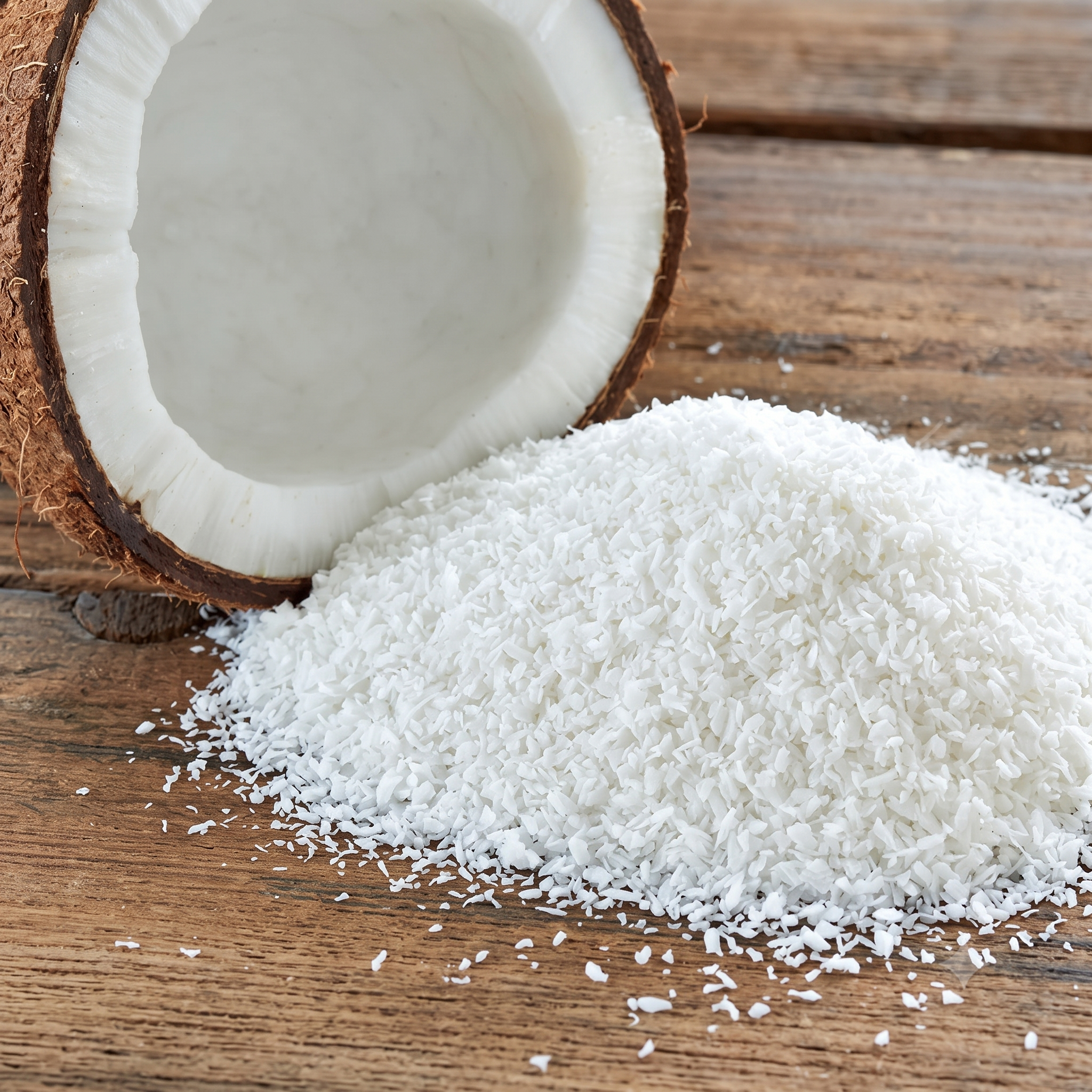
Desiccated Coconut
Coconuts are a way of life for millions of people around the world today in tropical climates. Known as the “tree of life,” the wonderful fruit of the coconut palm is rich in specific fats that have incredible health benefits. Traditional tropical populations that consume a lot of coconut oil are seldom overweight and traditionally have been free from the modern diseases that afflict most western cultures.
It finds extensive use in confectioneries, bakeries, puddings and many other food preparations as a substitute to raw grated coconut.
Manufacturing Process
It is simple and well-established. Fully grown and matured coconuts of around 1 year are stored with husk for about a month to facilitate absorption of water and separation of coconut kernels from shell walls. After de-husking, their shells are removed and brown portion (also known as Testa) is removed by scrapping it off and in this process around 12-15% of the kernel goes as paring which is further processed to obtain oil.
Subsequently, de-shelled coconuts are broken into pieces, washed and disintegrated in powder form. This powder is then dried in tray drier at about 80-90°C and powder is stirred occasionally to ensure uniform drying. On cooling, it is passed through vibratory screen with different mesh sizes to segregate the powder according to mesh size. Finally, it is ready for packing. The process flow chart is as under.
Desiccated Coconut is produced by a mechanical process of disintegrating, cleaned and dried pieces of pared kernel of fully matured and fresh coconut. The product should be natural white in colour. It shall have characteristic taste, Odor and flavor. It shall be free from cheesy, smoky, musty or any other objectionable Odors, fungus and insect infestation. It shall be crisp, free from rancidity and not show fat sweating. Desiccated Coconuts are graded by its cutting size, for example, fine grade and medium grade where fine grade is smaller particle size than the medium grade.
Yield of the product is 1 ton from 10,000 coconuts.
Specifications
| Moisture | 3% Max. |
|---|---|
| Protein | 6% Min. |
| Oil | 65% Min. |
| Carbohydrate | 18 - 72% |
| Crude fibre | 4 - 6% |
Applications of Desiccated Coconut
Desiccated Coconut is ideal for use as fillers, toppings and as ingredients, especially in the baking of biscuits, snack bars, cakes, cookies and so on.
How to identify a good quality Desiccated Coconut?
A good quality Desiccated Coconut should be white in colour, reasonably free from yellow specks, black spots and other discolorations. It should have sweet aroma of coconut, mild characteristic of coconut without rancid and even particle size distribution.
What are black spots in Desiccated Coconut?
Back spots are foreign materials found in Desiccated Coconut. These foreign materials are primarily the grated and dried coconut skin, which had gone through the cutting and drying processes together with the white coconut meat. There is no perfect, error margin is allowable at not more than 4 pieces of black spots in 100 g of desiccated coconut is acceptable.
Packing and Storage of Desiccated Coconut
Desiccated Coconuts are packed in multi-ply Craft paper bags with inner sealed polythene to keep away from the atmosphere’s moisture. Desiccated Coconuts are packed in 07 Kg, 10 Kg, 25 Kg or 50 Kg. Desiccated Coconuts shall be stored in cool and dry place. Avoid direct sunlight and strong Odor.